



Your Name
11hPublic
1,200
234 comments56 shares
LikeCommentShare
Check your Facebook post before you publish — the editor below shows where the ~480-character feed fold cuts your text and flags fancy Unicode fonts that break accessibility.
Everything below updates instantly and stays on your device.
Characters: 0 · Words: 0
Preview only — never uploaded or stored. Clears on reload.
Real-time analysis is on
Above-the-fold check
Add text to see what survives the fold.
Accessibility · fancy fonts
11hPublic
No pseudo-font characters detected. Your text reads cleanly on assistive tech.
Flesch Reading Ease
Overuse monitor
Start typing to see your most-used keywords and their density.
Facebook's technical character ceiling sits at a nearly unlimited 63,206 characters — far more than anyone should ever use for a feed post. The real constraint is behavioural, not technical. The feed truncates at approximately 480 characters with a "See More" link, and engagement data consistently shows that posts cleared well before that fold outperform long-form updates by a significant margin.
PostTruncate's Facebook character counter tracks your running total in real time with a colour-coded display, marking both the 80-character sweet spot and the 480-character fold so you can make an informed decision before publishing — not after watching your reach flatline.
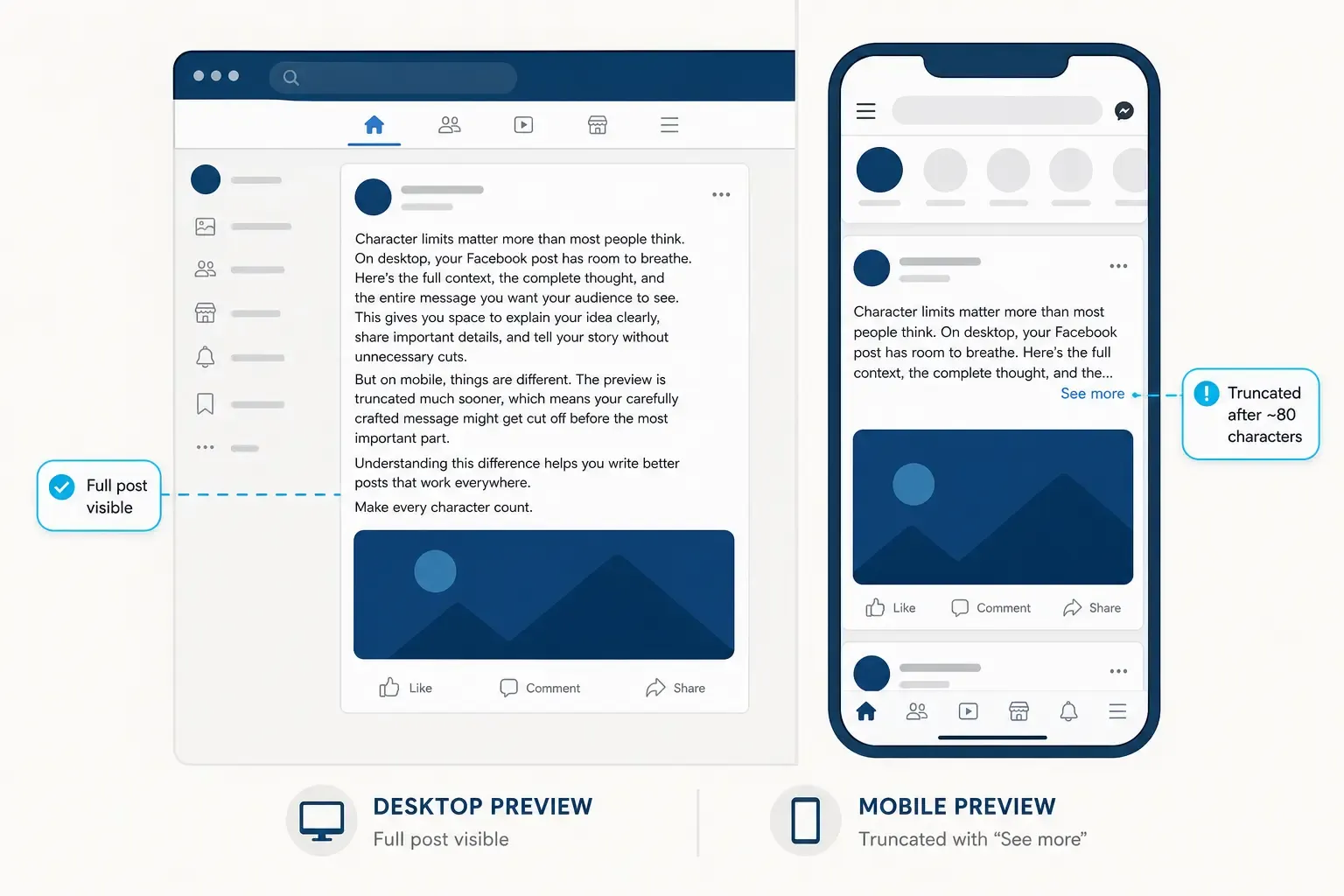
When a Facebook post exceeds approximately 480 characters in the feed, the platform collapses the remaining text behind a "See More" tap. This is not simply a display limitation — it is a friction point. Every additional tap required to read your full post is a drop-off opportunity, and mobile users in particular scroll past collapsed posts without engaging.
Posts that stay under the fold receive the full text treatment in the feed: no interruption, no tap required, no decision to make. The reader absorbs the entire message before they've consciously chosen to engage, which is exactly when organic sharing and commenting happens most naturally.
Facebook's own engagement research — and years of third-party analysis — point to the same conclusion: posts under 80 characters receive significantly higher like, comment, and share rates than longer equivalents. The reasons are straightforward. Short posts render fully at a glance on every device. They leave visual whitespace that makes the post feel less demanding. And they force the writer to say one thing clearly, rather than three things vaguely.
This doesn't mean every post should be a single sentence. It means the opening line — the part of the post visible before any tap — should be able to stand alone. If the whole message fits in 80 characters, publish it at 80. If it genuinely needs more, keep the essential point in those first 80 characters and expand below the fold.
A growing number of Facebook users copy-paste text formatted with Unicode lookalike characters — the kind that make regular letters appear bold, italic, or styled in novelty fonts without using actual formatting. These characters are not real text. They are symbols that happen to resemble letters.
The consequences are serious. Screen readers used by blind and low-vision users read these characters as garbled nonsense — a sentence formatted in Unicode bold becomes a string of incomprehensible symbol names. Beyond accessibility, Facebook's algorithm treats heavy use of pseudo-Unicode text as a spam signal, silently suppressing the post's organic distribution.
PostTruncate detects pseudo-Unicode characters in real time and flags them before you publish, so you can replace them with standard text and restore both accessibility and reach.
A single post can technically hold more than 63,000 characters, so length is rarely the wall. What matters is the feed fold: Facebook hides text after roughly 480 characters behind "See more."
Posts under about 80 characters consistently see higher engagement — they read fully in-feed without a "See more" click and feel more conversational. The counter above helps you keep it tight.
Those styled letters are pseudo-Unicode symbols, not real formatting. Screen readers skip or mangle them, which hurts accessibility and reach. The editor flags them so you can switch back to plain text.
Yes — emojis and the full link text count as characters in your post, even though Facebook also generates a separate link-preview card. The counter reflects the true character total.
12 min read
Facebook post character limits explained: 80-char engagement peak, 110-char mobile fold, 480-char desktop fold. Write posts that get seen on every device.
Read article →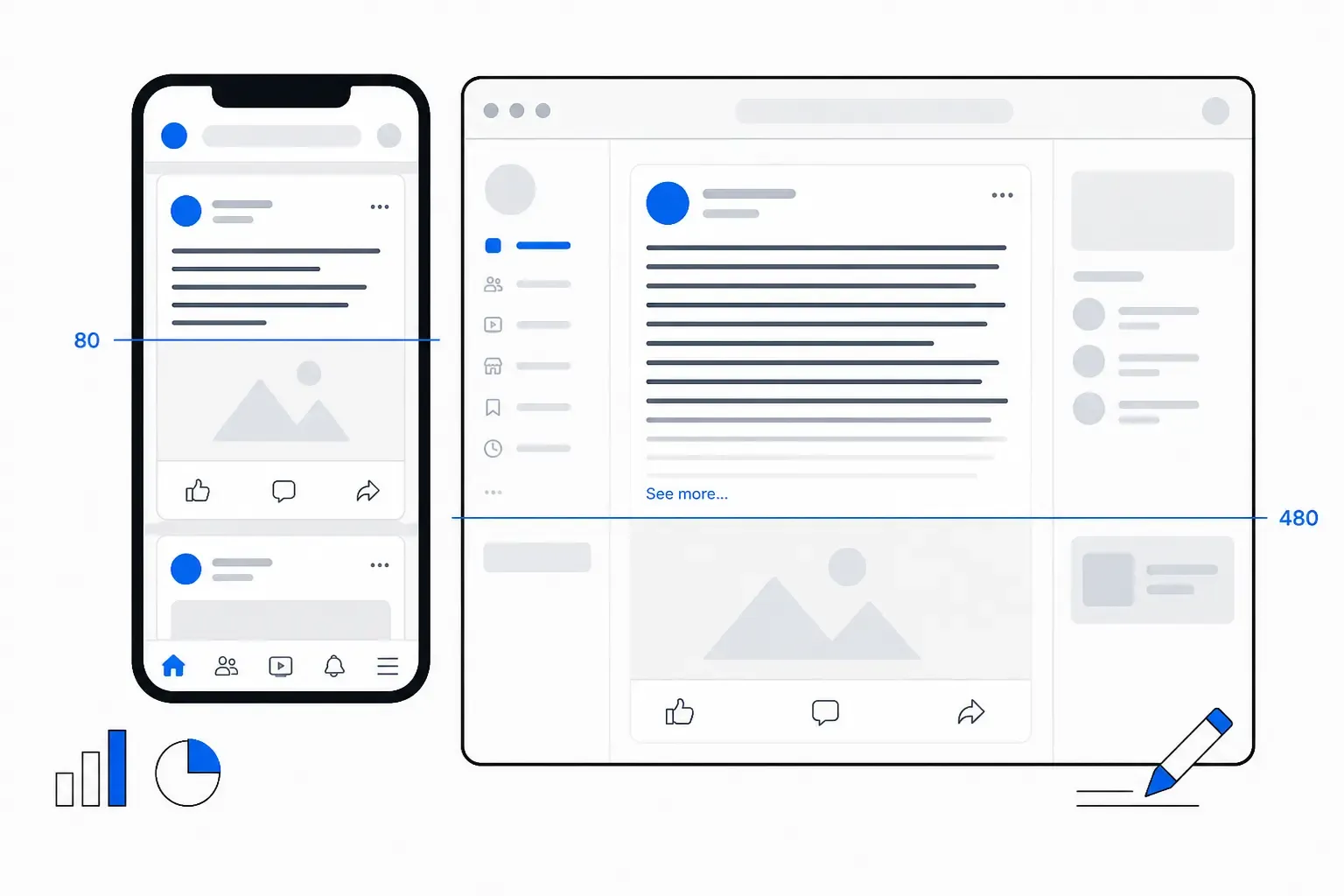
13 min read
Master Facebook in 2026: character limits by post type, how the feed fold works, and what actually drives reach - without paying for ads.
Read article →Last updated: June 1, 2026