



Facebook: character limits, the feed fold, and what gets reach in 2026
Facebook's real limits aren't the 63,206-character ceiling - they're the 480-char fold and the 80-char engagement peak. Here's what the platform actually rewards.
 By Anirudha Published

TL;DR
Facebook’s 63,206-character limit is a red herring. The constraints that actually determine whether your post gets seen are: the 80-character engagement peak (posts this short get 66% higher engagement), the 110-character mobile fold (what phone users see before scrolling), and the 480-character desktop fold (where text collapses behind “See more”). Posts that avoid the fold get more reach because they remove friction. Reels and videos now dominate the feed algorithmically. Pseudo-Unicode “fancy fonts” are silently suppressed. If you write for Facebook and care about reach, the character count that matters isn’t 63,206 - it’s 80.
Use PostTruncate’s free Facebook character counter to see exactly where your post folds on mobile and desktop before you publish.
Facebook’s actual character limits (the ones that matter)
Facebook will technically accept a post of 63,206 characters. That’s roughly the length of a short novel. Nobody uses that ceiling meaningfully, and the platform’s algorithm rewards brevity so heavily that you’d be working against yourself to even approach it.
The limits that actually affect reach operate well below the technical ceiling. There are three of them, and understanding all three changes how you write for the platform.
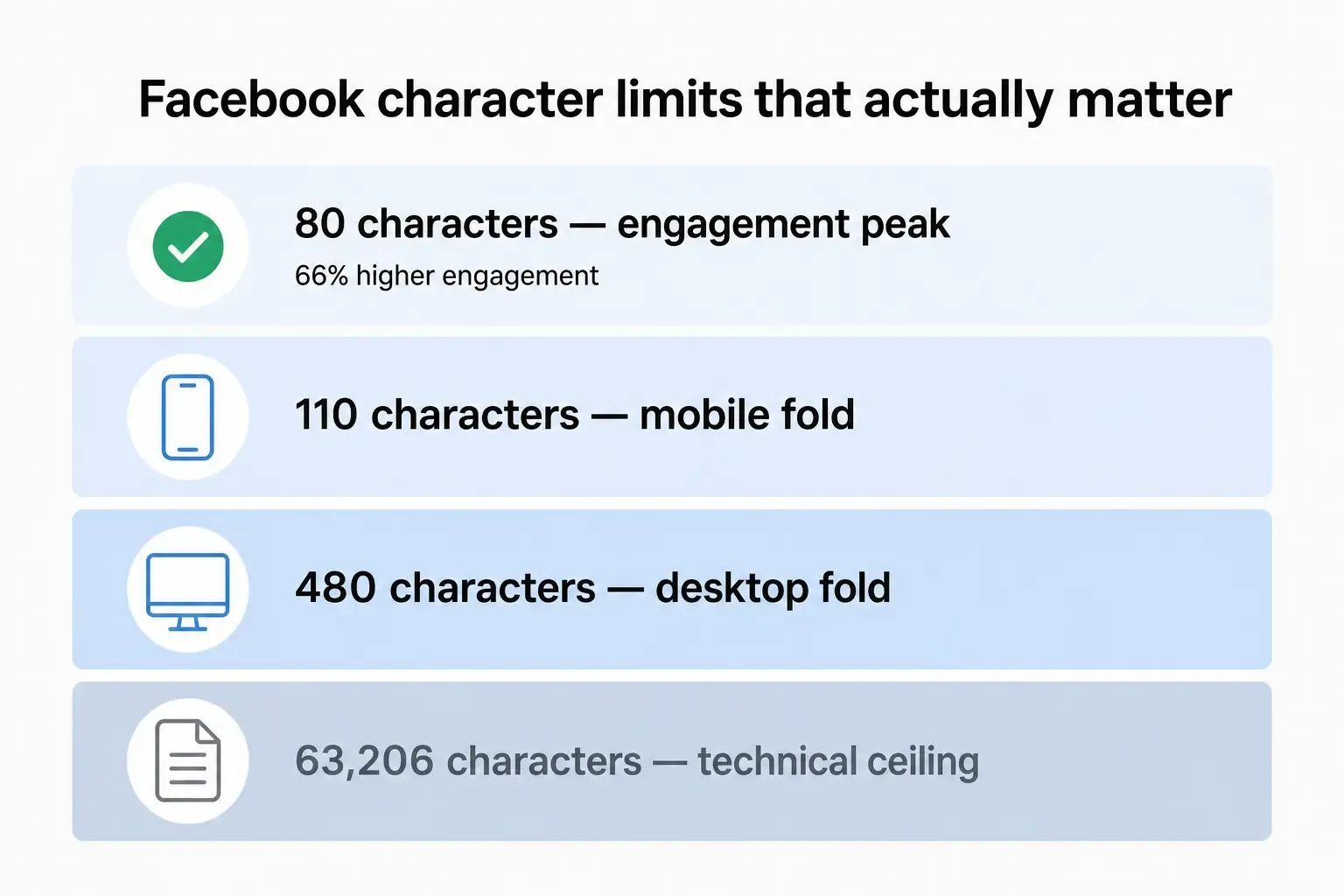
Facebook character limits that actually matter - showing engagement peak at 80 chars, mobile fold at 110, desktop fold at 480, and technical ceiling at 63,206
The 80-character engagement peak
Posts under 80 characters consistently outperform longer equivalents - not by a small margin. Research published by Hootsuite found that posts with 80 characters or fewer receive 66% higher engagement than longer posts. The reasoning is simple: short posts render fully at a glance on every device, leave visual whitespace that feels less demanding, and force the writer to say one thing clearly rather than three things vaguely.
This doesn’t mean every post should be a single terse sentence. It means the opening line - the 80 characters visible before any decision to engage - should be able to stand alone. If your whole message fits in 80 characters, publish it at 80. If it needs more space, put the hook there and expand below.
The 110-character mobile fold
Most people access Facebook on a phone. On mobile, the feed collapses posts after approximately 110 characters before showing a “See more” tap. That’s barely two sentences. A post that reads beautifully on a laptop may appear truncated and incomplete to the majority of your actual audience.
The mobile fold is the most overlooked constraint in Facebook content writing. Writers typically preview and draft on desktop, where 480 characters is the collapse point - and then their posts go out looking reasonable on the screen they wrote on while quietly underperforming with the majority of readers on phones.
The 480-character desktop fold
On desktop, Facebook collapses feed posts after roughly 480 characters with a “See more” link. Every additional tap required to read the full post is a drop-off opportunity. Mobile users scroll past collapsed posts without tapping. PostTruncate’s research shows that posts requiring expansion see measurably less engagement - the friction of one tap is genuinely enough to change reader behaviour.
Posts that stay under the fold get full-text display in the feed with no interruption. The reader absorbs the entire message before they’ve consciously chosen to engage, which is exactly when organic sharing happens most naturally.
The complete character limit table
| Content type | Limit | Notes |
|---|---|---|
| Feed post (engagement peak) | 80 chars | 66% higher engagement vs. longer posts |
| Feed post (mobile fold) | ~110 chars | What phone users see before “See more” |
| Feed post (desktop fold) | ~480 chars | Full text visible before truncation |
| Feed post (hard limit) | 63,206 chars | Technical ceiling; rarely relevant |
| Comment | 8,000 chars | Per-comment |
| Group post | 63,206 chars | Same as feed; different algorithm |
| Page name | 255 chars | Rarely hit in practice |
| Ad headline | 40 chars | Strict ad copy limit |
| Ad primary text (desktop) | 125 chars visible | Truncated in feed like regular posts |
| Ad primary text (mobile) | 90 chars visible | Tighter mobile truncation for ads |
How the Facebook feed algorithm works
The feed doesn’t show posts chronologically. It ranks content by predicted engagement - and the ranking signals Facebook uses are not secret, even if the exact weights are.
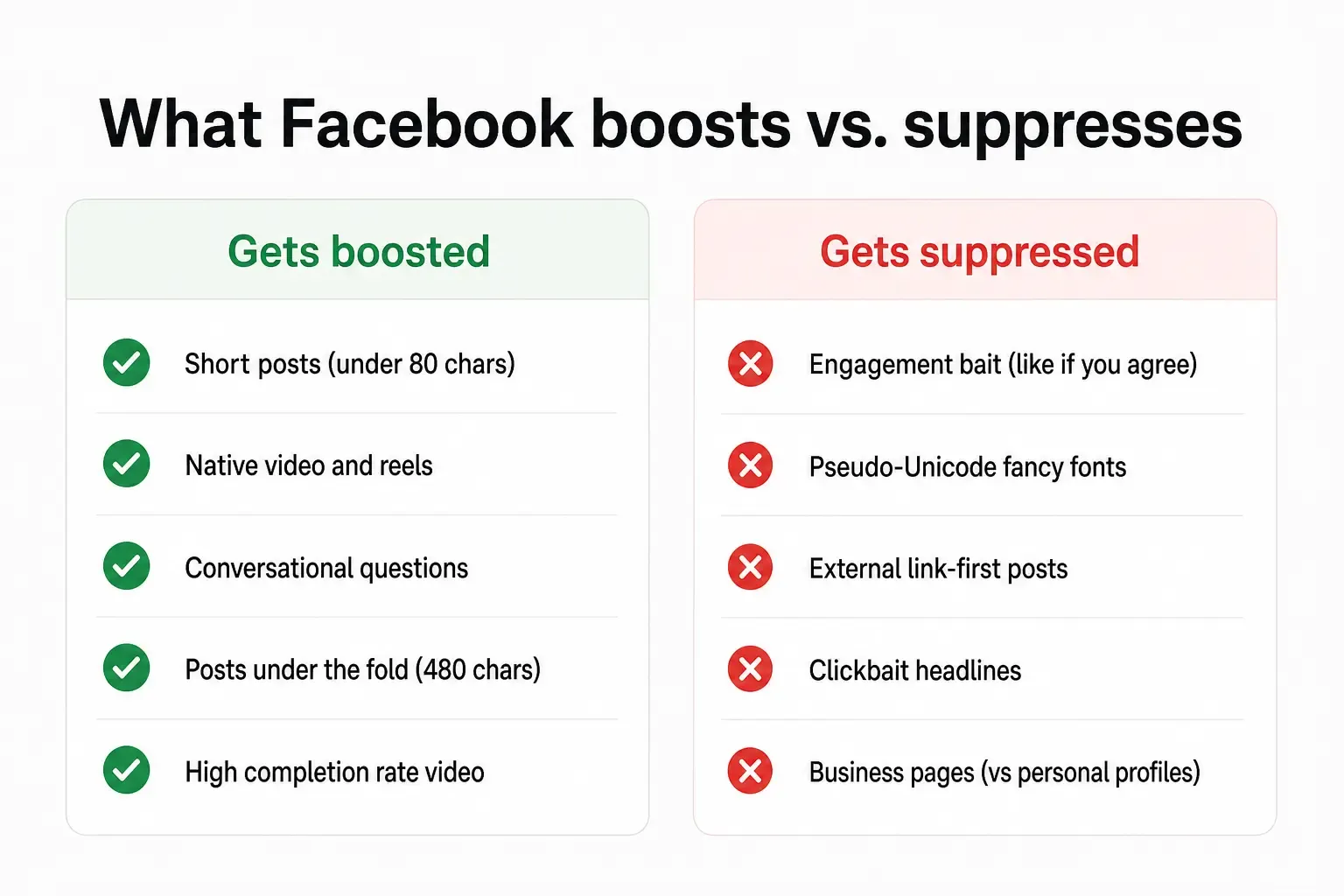
What Facebook's algorithm boosts vs suppresses - comparison infographic
Primary ranking signals
Shares carry the most weight. A shared post is one a user thought was valuable enough to spread to their own network - that’s a strong signal of quality. Comments come second: they require more effort than a like and indicate genuine engagement. Likes matter but are weighted least of the three. Dwell time - how long a user’s feed pauses on a post - is a secondary signal that has grown in importance.
For video and reels, completion rate is the key signal. A 15-second reel that most viewers watch to the end outperforms a 60-second reel with high drop-off. Hook the viewer in the first second.
What boosts reach
Short posts that fit under the 480-character fold have lower friction and attract more initial engagement, which starts the algorithmic ranking loop. Posts under 80 characters see this effect at its strongest. Conversational posts that invite genuine discussion (not bait) see higher comment rates. Native video hosted directly on Facebook gets preferential treatment over external links - keeping users on-platform is Meta’s incentive.
Posts from personal profiles consistently outrank business pages organically. This isn’t accidental: Meta’s 2018 algorithm shift explicitly prioritised “meaningful social interactions” from friends and family over brand content.
What suppresses reach
The algorithm actively penalises several patterns:
Engagement bait - posts that explicitly ask for likes, comments, or shares without offering genuine value (“like if you agree”, “tag a friend who needs this”) - are suppressed by up to 50% or more in reach. Facebook has been enforcing this since 2017, and it’s only gotten stricter.
Pseudo-Unicode fonts are algorithmically treated as a spam signal. These are the “fancy” styled letters - bold, italic, decorative - that look formatted but are actually Unicode symbol characters, not real text. PostTruncate detects these in real time and flags them before you publish. They’re doubly harmful: beyond the reach penalty, screen readers used by blind and low-vision users render them as garbled nonsense. A post that looks bold and attention-grabbing to a sighted user may be completely inaccessible to a significant portion of your audience.
External link-first posts that exist primarily to drive traffic off Facebook get lower organic reach. Facebook prefers keeping users on-platform.
Facebook post types: a field guide
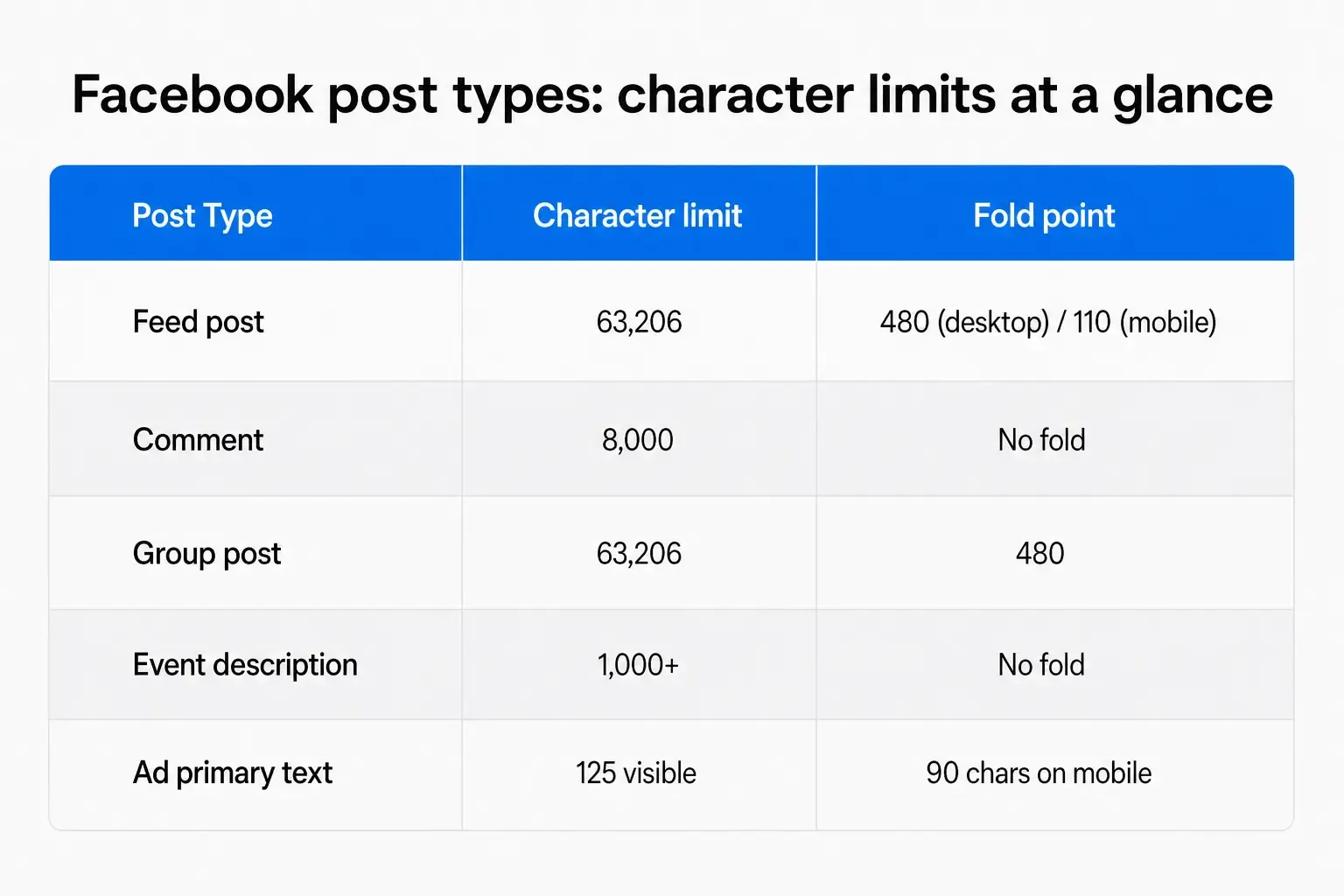
Facebook post types character limits comparison table
Feed posts
The default post type - text, images, or video shared to your timeline or page. This is where the 80/110/480 character logic applies most directly. For organic reach, a short text post with a strong hook or a compelling image consistently outperforms a long-form update. If you’re writing a post that needs more than 480 characters, make sure the opening 80 characters can stand alone.
A practical note on links: a full URL counts every character toward your total. The link preview card Facebook generates is separate from the post’s character count. If you’re linking to a long URL, use a shortener to preserve your character budget for the message itself.
Reels
Short-form vertical video - Facebook’s response to TikTok, and increasingly the platform’s highest-priority content type. By 2025-2026, practitioners consistently report that reels achieve 3-5x the organic reach of equivalent text or static image posts. The algorithm weights completion rate heavily for reels - shorter videos that viewers watch to the end outperform longer videos with drop-off. Text captions on reels follow the same feed post fold rules.
Stories
Ephemeral content that disappears after 24 hours. Stories have a different character model than feed posts - text overlays on images or video can contain any length of text, but the practical constraint is mobile readability. Stories are viewed at small screen sizes; anything more than a handful of words becomes illegible. Think of story text as a caption, not an essay.
Group posts
Groups operate on a different algorithmic model than the main feed - less ranking-heavy, more chronological. Posts in groups stay visible for longer than feed posts, and the engagement pattern looks different: more comments and discussion, fewer shares. The same character limits apply (63,206 hard ceiling, 480-char fold), but the audience context is different. Group members have opted in to a community; they’re often more tolerant of longer, more substantive posts than the scrolling main feed audience.
Business pages
Pages face a structural disadvantage: organic reach from brand pages is lower than from personal profiles by design. Meta’s algorithm explicitly favours friend-and-family content. Pages see better results combining organic posts (for community building and credibility) with paid amplification for reach. For organic page posts, the character optimisation logic applies even more strongly - shorter, more engaging content is your best tool against algorithmic headwinds.
Facebook Ads
Ads have tighter constraints than organic posts. The headline limit is 40 characters - strict, not a guideline. The primary text field is technically long-form, but only 125 characters appear on desktop and 90 characters on mobile before a “See more” collapse. Your ad’s first 90 characters need to carry the message independently for mobile audiences. Descriptions are limited to 30 characters.
Writing for the Facebook feed: what actually works
From practitioner research and platform data, a few things consistently separate high-reach posts from low-reach ones.
Front-load the value. The first 80 characters are visible at a glance on every device. Put the most compelling, specific, or surprising element of your post right there - not as setup, not as context, but as the hook itself. A post that opens with “We reduced customer churn by 40% last quarter” outperforms one that opens with “I’ve been thinking about customer retention lately and wanted to share some thoughts.” The latter wastes the visible fold on setting up the reader, who doesn’t yet care about it.
Use specificity, not vagueness. Numbers and concrete claims perform measurably better than abstract ones. Compare: “Our process saves time” vs “Our process cuts reporting from 4 hours to 20 minutes.” The second post gives readers something to react to. Vague claims require a “see more” tap to become meaningful; specific claims land at a glance.
One idea per post. Posts that try to make multiple points force readers to keep reading to understand what the post is actually about. A post with one clear, specific point can deliver it in 80 characters. Multi-point posts almost inevitably need the fold - and the fold costs engagement.
“The opening line is everything. If those first 80 characters don’t grab someone, they scroll past. Full stop. We write the hook first, then expand if we need to. Most of the time, we don’t need to.”
Don’t use engagement bait. Posts that ask for likes, comments, or shares explicitly (“like if you agree”) are suppressed. The irony is that posts genuinely worth engaging with don’t need to ask. If your content is specific, relevant, and says something worth reacting to, engagement follows without prompting.
Check both folds before publishing. A post that looks clean at 300 characters on your desktop preview still collapses before 110 characters on the phones your readers are using. The most common mistake is writing and previewing on desktop, publishing, and then watching the post underperform with a mobile audience that saw a truncated version with no compelling reason to tap “See more.”
PostTruncate for Facebook
PostTruncate’s Facebook character counter is a free, browser-based tool that shows you exactly where your post folds - on both mobile (110 chars) and desktop (480 chars) - before you publish. Type your post, and the tool renders a live preview with fold markers, colour-coded character count, and a real-time flag for pseudo-Unicode fonts that would suppress your reach.
PostTruncate Facebook character counter showing live fold markers on mobile and desktop, as taken from PostTruncate
Everything runs client-side - your text never leaves your browser, there’s no account required, and the tool is completely free. PostTruncate covers all major platforms in one interface: Facebook, LinkedIn, X (Twitter), Instagram, Threads, and SMS - so you can see how the same content performs across every channel before posting anywhere.
FAQs
What is Facebook's character limit for posts in 2026?
Facebook's technical character ceiling is 63,206 characters - far more than anyone should use. The real limit that determines reach is behavioural: the feed fold collapses text after roughly 480 characters on desktop and 110 characters on mobile. Posts under 80 characters consistently see the highest engagement rates. Use PostTruncate's Facebook character counter to see exactly where your post folds in real time.
What is the ideal length for a Facebook post?
Empirically, posts under 80 characters receive about 66% higher engagement than longer posts. If your message genuinely needs more space, keep the essential hook in the first 80 characters and expand below - but anything past the 480-character fold gets hidden behind a 'See more' tap and receives measurably less reach. Check the fold before you publish with PostTruncate.
How does the Facebook algorithm decide what to show?
Facebook ranks posts by engagement signals: likes, comments (weighted more heavily), shares (weighted most heavily), and dwell time. Posts that stay under the 480-character fold have lower friction and attract more initial engagement. Videos and reels are increasingly prioritised. The algorithm actively suppresses engagement bait (posts that ask for likes/comments without value) and pseudo-Unicode fonts.
Do emojis and links count toward Facebook's character limit?
Yes - emojis count as single characters in Facebook posts, and the full URL text counts too (Facebook generates a separate link preview card, but the raw text in your post still adds to your count). Use PostTruncate's Facebook character counter to track your running total in real time, including emoji and link characters.
What are pseudo-Unicode fonts and why does Facebook suppress them?
Pseudo-Unicode fonts are text styled to look bold, italic, or decorative using symbol characters rather than real letters - the kind you copy-paste from a 'fancy text generator.' Facebook's algorithm treats these as a spam signal and silently suppresses the post's reach. They also render as garbled nonsense for screen readers used by blind and low-vision users. PostTruncate detects pseudo-Unicode characters in real time so you can fix them before publishing.



Join the discussion
Comments are reviewed before they appear, so yours won’t show up right away.