



Why Do Social Platforms Truncate Posts? Psychology of Character Limits
Character limits aren't arbitrary - they trace back to a typewriter experiment in 1985 and exploit deep cognitive psychology. Here's the full story.
 By Anirudha Published
TL;DR
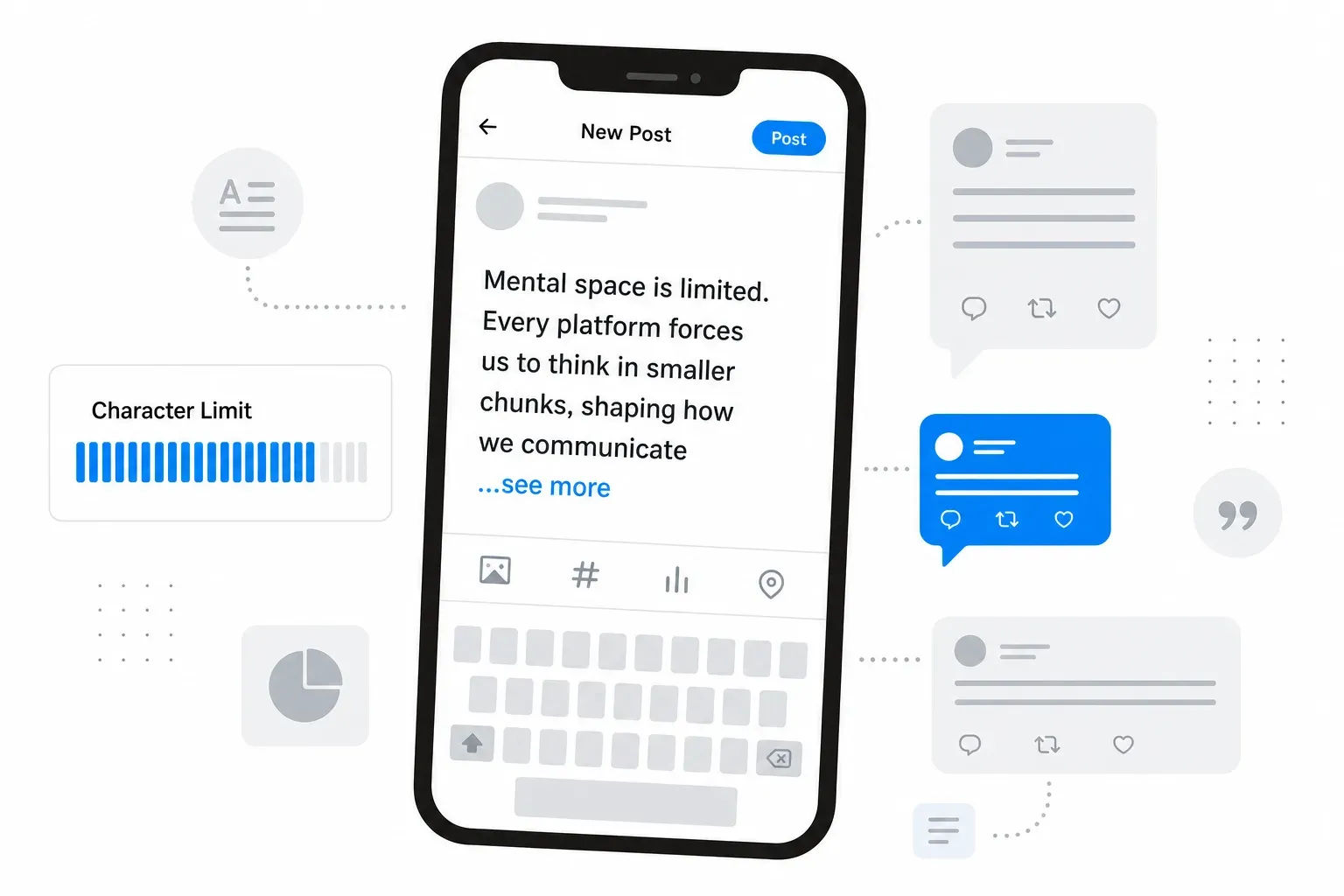
Every character limit on social media traces back to a single decision made in a room in Bonn, Germany, in 1985 - and the psychological mechanisms they accidentally discovered along the way are why platforms still use them today. The 160-character SMS limit wasn’t based on research or user testing. It was based on Friedhelm Hillebrand sitting at a typewriter and counting the characters in random sentences he typed until he noticed they almost all came in under 160. Twitter borrowed 140 of those characters in 2006. Every platform that followed built on that foundation. But here’s what nobody talks about: the limits work not just because they force brevity, but because truncation - the “see more” - exploits a deep cognitive bias called the Zeigarnik effect. Your brain won’t let you scroll past an unfinished sentence. That’s not an accident. It’s the whole game.
I want to tell you something I didn’t expect to find when I started digging into this topic: the most consequential number in the history of digital communication was set by a man counting the characters in his own birthday card drafts.
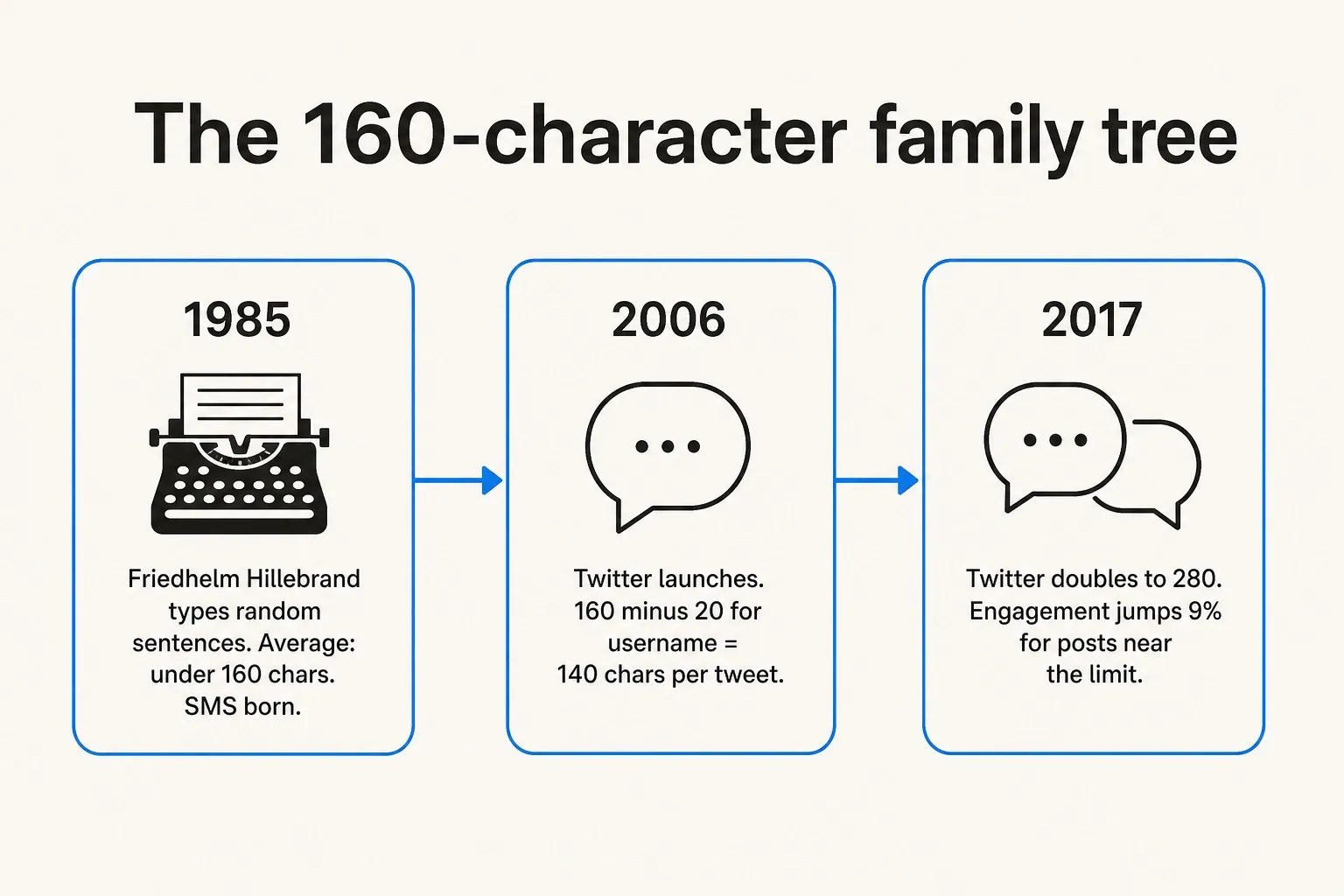
Friedhelm Hillebrand was 45 years old in 1985, sitting alone at his typewriter in Bonn, typing random sentences and questions - not for any audience, just as an experiment. He counted the characters in each one. Nearly every sentence he typed came in under 160. “This is perfectly sufficient,” he later told the Los Angeles Times. “Perfectly sufficient.”
That moment gave SMS its character limit. And SMS gave Twitter its character limit. And Twitter, more than any other single platform, shaped how every social network after it thought about message length.
We’re all still living downstream of a typewriter experiment that took one evening.
The origin story most people get wrong
The common version of this story is that character limits are technical constraints - a product of narrow bandwidth, hardware limitations, the legacy of slower networks. That’s partially true. But the technical story is more interesting than the summary, and the human story behind it is even better.
In 1984, Hillebrand and engineer Bernard Ghillebaert were working within the Franco-German GSM cooperation - the group that would go on to define the mobile communications standards the world still uses. They needed to figure out how to carry text messages over mobile networks, and they faced a real physical problem: the GSM standard’s control channel - the secondary radio link used to manage call setup and signal strength - had only 140 bytes of usable space. At 7 bits per character (the GSM-7 encoding), that worked out to exactly 160 characters.
But 140 bytes wasn’t the starting point. Initially, Hillebrand’s team could only squeeze 128 characters into that space. Getting to 160 required deliberate engineering: they trimmed down the set of letters, numbers and symbols the system could represent, bought back 32 characters of headroom, and landed on 160 as the ceiling.
The question then was: is 160 enough? They had zero market research. So Hillebrand validated the number with two things he could actually check. First, postcards - he looked at a sample and found most ran under 150 characters. Second, Telex messages - the business telegraphy network that preceded SMS - which, despite having no technical limit, tended to run about postcard length anyway. The assumption was that professional short-form communication had a natural gravity toward brevity, and 160 characters would capture it.
He was right. But he had no idea how right, and in ways he couldn’t have anticipated.
The 160-character family tree - showing how SMS (1985), Twitter 140 (2006), and Twitter 280 (2017) connect
How 160 became 140 became everything
When Twitter launched in 2006, co-founder Jack Dorsey and the team made a simple calculation: SMS messages top out at 160 characters, and if you want tweets to work via text message - which was the original distribution mechanism - you need to leave room for the sender’s username. Twenty characters for the username, 140 for the tweet. That math gave Twitter its identity.
What Twitter didn’t anticipate was that the 140-character limit would become a cultural force. It made Twitter feel urgent, punchy, and real-time in a way that blogs and forums didn’t. It made brevity a craft. Whole genres of writing emerged around fitting a complete thought into 140 characters. And when Twitter doubled the limit to 280 in 2017, the reaction from long-time users was almost universally that something had been lost - even though they had more room.
The interesting part of that 2017 change: Twitter found that posts closer to the 280-character limit got more likes and replies per impression. More room didn’t just mean more words. It meant writers could be more considered, add more context, and make a tighter argument. The quality of content went up even as brevity nominally went down.
That finding - that limits can improve quality by forcing precision, and that relaxing them also improves quality by allowing nuance - is the central paradox of character limits. There’s no universally correct length. There’s only the question of what the constraint is trying to accomplish.
The feed fold is a different animal
Here’s where it gets more psychologically interesting, and where most advice about character limits misses the actual mechanism.
Most platforms don’t stop you at their character limits in the feed - they truncate. They cut your post at a certain point and show “…see more” to anyone who wants the rest. This is a fundamentally different design choice from a hard cap, and it serves different purposes.
The hard limit controls what the writer does. The fold controls what the reader sees.
Platforms use folds to manage attention and engagement simultaneously. By truncating posts in the feed, they do three things. First, they keep the feed visually scannable - a feed of full posts would be walls of text. Second, they create a selection mechanism: only readers motivated enough to tap “see more” finish your post, which means your completion rate is a signal of actual engagement rather than passive scroll-past. Third - and this is the mechanism that matters most - they exploit a well-documented cognitive phenomenon.
The Zeigarnik effect and the unfinished sentence
In 1927, Soviet psychologist Bluma Zeigarnik noticed something strange: waiters at a Vienna restaurant could hold complex unpaid orders in their heads perfectly, but couldn’t recall the details of orders that had already been settled. The act of completing a task seemed to free the brain from holding it. But incomplete tasks stayed active, hogging mental bandwidth until they were resolved.
The Zeigarnik effect - the tendency to remember and fixate on unfinished tasks more than completed ones - is now one of the most replicated findings in cognitive psychology. And it is why “…see more” works.
When your post is truncated mid-thought, you have created an open loop in the reader’s brain. The sentence is unfinished. The story is incomplete. The argument hasn’t landed yet. A reader who would have scrolled past a fully visible post is now compelled - literally by the cognitive wiring of their own brain - to either close the loop by tapping or carry the itch of incompleteness as they keep scrolling.
Platform designers didn’t sit down and say, “We’ll deploy the Zeigarnik effect in our feed fold.” But whether by instinct, testing, or accident, they landed on a mechanism that exploits it perfectly. The fold isn’t just a display choice. It’s a psychological trigger.
“The Zeigarnik Effect makes the unresolved content memorable, while curiosity makes it compelling.” - ImpulseBuyingPsychology.com
What cognitive load theory adds
The Zeigarnik effect explains why truncation works to drive engagement. Cognitive load theory explains why the limits themselves - even without truncation - serve real human needs.
George Miller’s 1956 paper “The Magical Number Seven, Plus or Minus Two” established that working memory has a hard capacity limit: humans can hold roughly 7 (plus or minus 2) chunks of information in conscious attention at once. Reading a long, dense social media post requires holding earlier points in memory while processing new ones - and when working memory fills up, comprehension drops.
Short-form content sidesteps this problem. A well-written tweet or LinkedIn post delivers a complete thought inside working memory’s comfortable range. The reader doesn’t have to juggle what they’ve already read while absorbing what comes next. The message lands clean.
This is why short posts often outperform long ones on platforms designed for feed browsing - not because audiences are shallow, but because they’re cognitively efficient. They’re not choosing brevity; their brains are choosing it for them, unconsciously preferring content that resolves quickly and completely within the limits of attention.
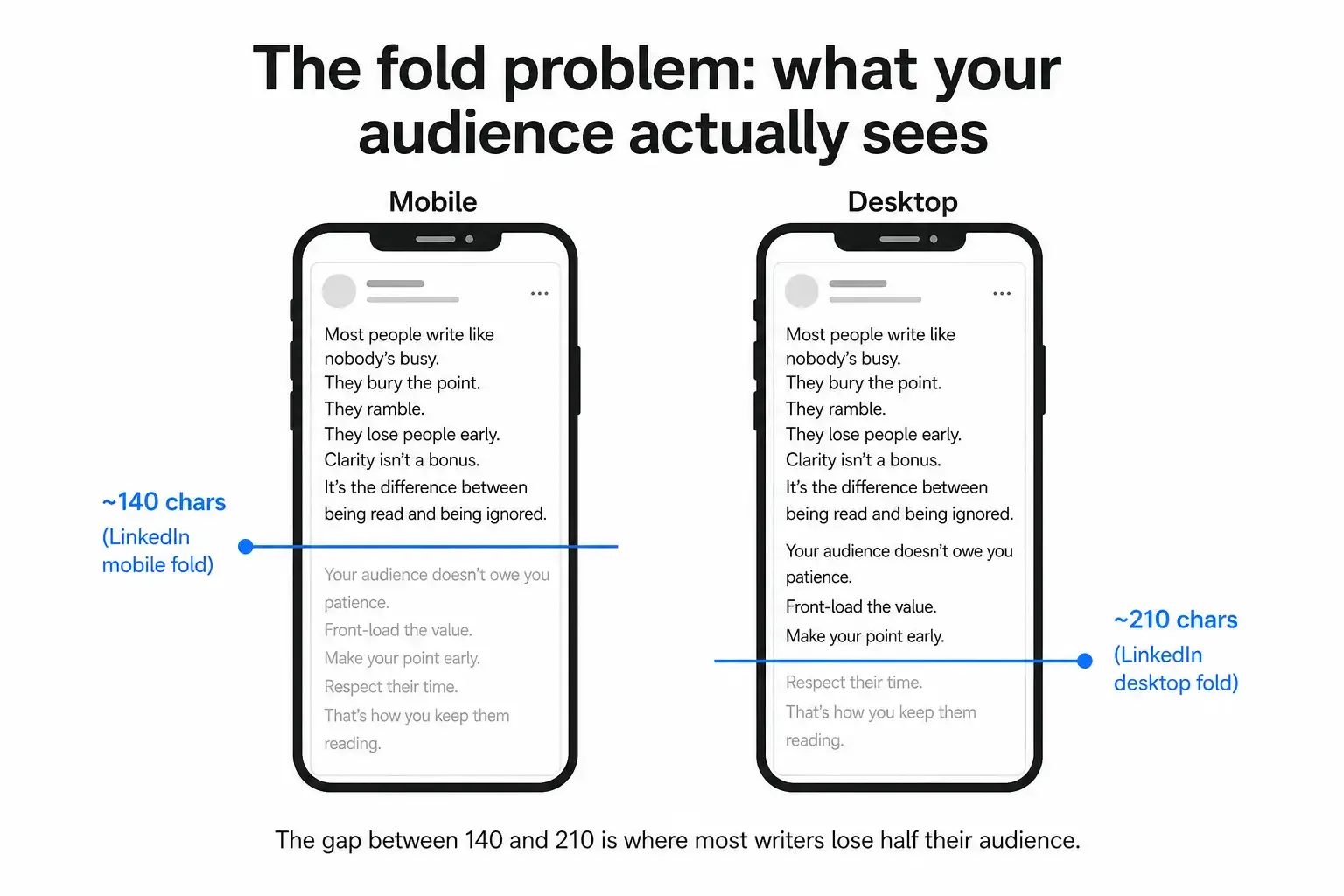
Diagram showing the LinkedIn mobile fold at \~140 characters vs the desktop fold at \~210 characters, illustrating how most audience members see less than you think
Each platform made different choices - and for different reasons
The fascinating thing about the current landscape is that every major platform has converged on a different answer to the same question: how much text should a person be allowed to post? Those differences tell you a lot about what each platform thinks it is.
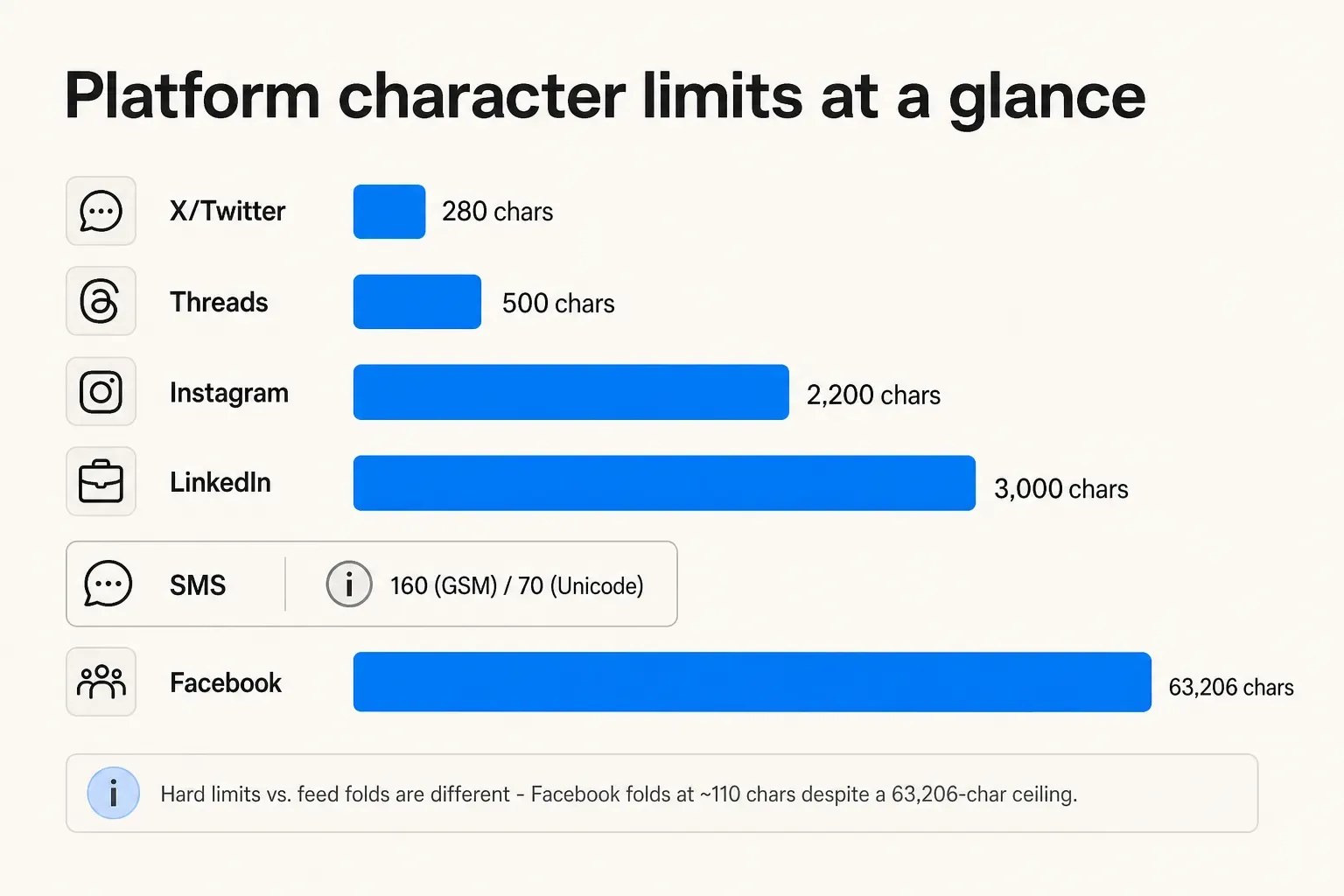
| Platform | Hard limit | Mobile fold | Desktop fold |
|---|---|---|---|
| X (Twitter) | 280 | None | None |
| Threads | 500 | ~250 | 500 |
| 2,200 | ~125 | ~125 | |
| 3,000 | ~140 | ~210 | |
| 63,206 | ~110 | ~480 | |
| SMS (GSM) | 160 | None | None |
X has no fold - just a hard 280-character ceiling. The product bet is that limiting total length is enough; whatever you write, the reader sees all of it or scrolls past. This keeps X posts maximally punchy and penalises anyone who writes prose that needs context.
LinkedIn uses a small fold with a generous limit - 3,000 characters behind a fold at ~140 mobile and ~210 desktop. This is a conscious bet that professional content earns deeper reading - but only if the opening line is strong enough to earn the “see more” tap. The dual-fold structure (different on mobile and desktop) is something most LinkedIn guides ignore completely, and it’s probably the most important thing to know about writing for the platform.
Facebook has the most interesting gap between its hard limit and its fold. The technical ceiling is 63,206 characters - essentially no limit. But the mobile fold kicks in at just 110 characters. The practical implication: Facebook doesn’t want long posts to win in the feed. Long posts can exist; they just have to earn their way past the fold. The gap between 110 and 63,206 is a filter, not an invitation.
Instagram’s fold is aggressive and symmetrical at roughly 125 characters on both mobile and desktop. For a platform built on visual content, the text is explicitly secondary - you get about a sentence to make your case before the caption disappears. This shapes Instagram writing profoundly: captions tend to be either very short (complementing the image) or very long and deliberately structured for deep readers who tap through.
Threads occupies an interesting middle ground at 500 characters - closer to Twitter’s original spirit than LinkedIn’s professional register, with a fold that appears at about 250 on mobile. It’s the platform most explicitly designed for conversation, and its limits reflect that.
The dark side of limits: what research actually found
A 2025 study published in Management Science - “Too Long, Didn’t Read? The Impact of Length Limits on Microblogging Engagement” - ran a natural experiment on a major Chinese microblogging platform that rolled out character limit extensions in phases. The findings complicate the simple “shorter is better” narrative considerably.
Extending the character limit significantly increased the total number of daily posts. But only from already-active users - less active users showed almost no change in posting behaviour. And perhaps most importantly, longer posts received more likes, not fewer. The quality signal from readers went up when writers had more room.
The researchers also flagged a structural risk: expanding limits “risks further concentrating content generation from the vocal minority, thereby making the silent majority less visible on the platforms.” More room to write means more power to people who were already writing a lot.
The takeaway isn’t that limits are bad or that removing them is good. It’s those limits that shape the distribution of who writes and how much - and that’s a design choice with real social consequences. When platforms set character limits, they’re not just engineering attention. They’re engineering participation.
Bar chart showing character limits across major platforms - X at 280, Threads at 500, Instagram at 2200, LinkedIn at 3000, Facebook at 63206
Why this matters for how you write
Understanding the psychology behind character limits isn’t just interesting history. It changes how you approach every piece of social content you write.
The fold is the only limit that matters for your audience. Most writers think about the hard limit - “can I fit this in 280 characters?” But the hard limit is a technical constraint for the writer. The fold is a psychological moment for the reader. Every platform truncates before its hard limit, and the fold is where your hook either earns the rest of the read or doesn’t.
Front-loading isn’t a stylistic choice; it’s a response to cognitive economics. Your reader’s attention is finite. Mobile LinkedIn users see your first 140 characters before deciding whether you’re worth a tap. If your opening is throat-clearing - context-setting, preamble, “I’ve been thinking about this for a while” - you’ve burned your entire mobile window on nothing. The most specific, surprising, or useful thing in your post should be the first sentence. Always.
The Zeigarnik effect is something you can write toward. An open loop - a question unanswered, a tension unresolved, a story started but not finished - doesn’t just drive “see more” taps. It makes your post memorable even for readers who don’t tap through. The incomplete thought stays with them. That’s worth more than a complete thought they forget immediately.
Constraints genuinely improve writing. This sounds obvious, but the research bears it out: when the Management Science study found that longer posts got more likes, it wasn’t because length was the variable - it’s because having more room let writers construct better arguments. The same dynamic works in reverse: tight limits force you to cut until only the essential remains. Hillebrand was right. 160 characters really is perfectly sufficient for most thoughts - not because most thoughts are small, but because most thoughts can be compressed without losing their essence once you’re forced to try.
PostTruncate
If you’ve ever published a post only to discover that the line you thought was your hook was buried three lines below the fold, that frustration is exactly what PostTruncate is built to solve.
PostTruncate is a free, browser-based character counter and live platform preview tool. As you type, it shows you exactly where each platform’s fold falls - including the often-missed mobile/desktop split on LinkedIn. You can see your post rendered in native LinkedIn, X, TikTok, Instagram, Facebook, Threads, and SMS previews simultaneously, with fold markers live in the text, thread splits calculated automatically, and SMS encoding detected in real time.
Everything runs in your browser. No account. No data uploaded. No server contact. Just you, your draft, and an honest picture of what your audience will actually see.
PostTruncate character counter tool showing live platform previews with fold markers, as taken from PostTruncate
The platform limits page has every limit and fold point in one place if you need a quick reference. And if you write primarily for LinkedIn, the LinkedIn character counter tracks both fold lines simultaneously - the one most LinkedIn writers don’t know about, and the one they do.
Every character limit on social media is a legacy of a decision made with incomplete information and no market research. But the platforms that built on those legacies discovered something real: constraints shape behaviour, and the fold in particular exploits cognitive mechanisms that are as old as attention itself. Friedhelm Hillebrand didn’t design the Zeigarnik effect. He just happened to stumble on a number that fits inside it.
FAQs
What is the difference between a hard character limit and a feed fold?
A hard limit is the maximum number of characters a platform will accept - post beyond it, and you can't publish. A feed fold (also called truncation) is where the platform hides your post behind a 'see more' link in the feed, even though it accepted more text. Facebook's hard limit is 63,206 characters, but its mobile fold collapses posts at just 110 - so the practical writing limit is the fold, not the technical ceiling.
Why does LinkedIn have two different fold points?
LinkedIn truncates posts at roughly 140 characters on mobile and 210 characters on desktop. This matters because the majority of LinkedIn browsing happens on mobile, so a post that hooks beautifully at character 180 will perform well on desktop but fail completely for the mobile audience - which is most of your reach. PostTruncate shows both fold lines live as you type, so you can write for both.
Does writing shorter posts actually improve engagement?
The evidence is mixed and platform-specific. Posts under 250 characters can see up to 60% higher engagement on some platforms, according to commonly cited social media benchmarks. But a 2025 study in Management Science found that extending character limits increased likes per post - suggesting that when writers have more room, quality improves even if brevity still wins in the feed. The real lesson: write to the fold, not the limit. Front-load your value, and let the rest sit below 'see more' for those who want it.
How do I know where each platform will cut my post?
Every platform has different truncation rules, and they change without notice. The most reliable way is to use a live preview tool like PostTruncate, which shows real-time fold markers for LinkedIn, X, TikTok, Instagram, Facebook, Threads, and SMS as you type. You can see exactly which words fall inside the mobile window, which appear only on desktop, and what disappears behind 'see more' - before you publish.

Join the discussion
Comments are reviewed before they appear, so yours won’t show up right away.