



Cross-Platform Social Strategy: Adapt, Don't Duplicate
Master multi-platform posting without burning out. Learn to adapt one post across LinkedIn, X, Instagram & more-with real workflows from teams that do it well.
 By Anirudha Published

TL;DR
Cross-platform social media success isn’t about copy-pasting the same post everywhere-it’s about starting with one core message and adapting it for each platform’s unique audience and culture. LinkedIn rewards long-form professional insights; X wants snappy commentary; Instagram needs visual-first thinking; TikTok thrives on authenticity over polish. The teams that win spend 3-4x longer creating adapted versions than broadcasting generic posts, but they do it efficiently using batching workflows and preview tools like Posttruncate to see exactly how their content will land before publishing. One message, multiple executions-not copy-paste, strategic adaptation.
Why Most Teams Get This Wrong
You have 1,200 words of insight to share. X gives you 280 characters. LinkedIn lets you breathe with 3,000. Instagram’s mobile fold cuts off anything past the first 125 characters. Facebook’s “See More” collapse on desktop hides everything after ~110 characters of preview text.
The instinct is to post one version everywhere and let the platform algorithm sort it out. That approach tanks engagement because each platform’s audience shows up expecting platform-appropriate content, not a generic broadcast. A thoughtful LinkedIn article gets scrolled past on TikTok. A 30-second TikTok trend you adapted doesn’t make sense for your B2B audience on X.
The platforms themselves engineered this problem on purpose. Character limits, feed algorithms, and content formats aren’t accidents-they’re deliberate constraints that shape how communication works on each platform. Respect those constraints, and you win. Fight them by copy-pasting, and your content gets buried.
The Core Principle: One Message, Multiple Executions
Think of it like this: you have one core insight or story. The message stays consistent. The execution changes completely.
Same message, different platforms:
Original insight: “Most social posts fail not because of bad writing, but because people don’t anticipate how platforms will truncate them.”
- LinkedIn version (1,200 words, professional tone): Deep-dive into platform fold psychology, how each platform’s feed design shapes engagement, why knowing your platform’s specific character limits matters, research-backed tactics
- X thread version (5-6 tweets): Snappy takes on the insight, questions that invite replies, data points that surprise, conversational tone
- Instagram caption (visual-first): Behind-the-scenes story of noticing the pattern, 1-2 emotional hooks, call to action driving engagement or saves
- TikTok version (15-30 seconds): Authentic commentary, surprising data point, trend-aware format, humour if it lands naturally
All are saying the same thing. None of them is a word-for-word copy. Each respects what works on its platform.
Platform-Specific Strategies
Not all platforms are created equal. Understanding what each platform wants from content is the difference between being ignored and being seen.
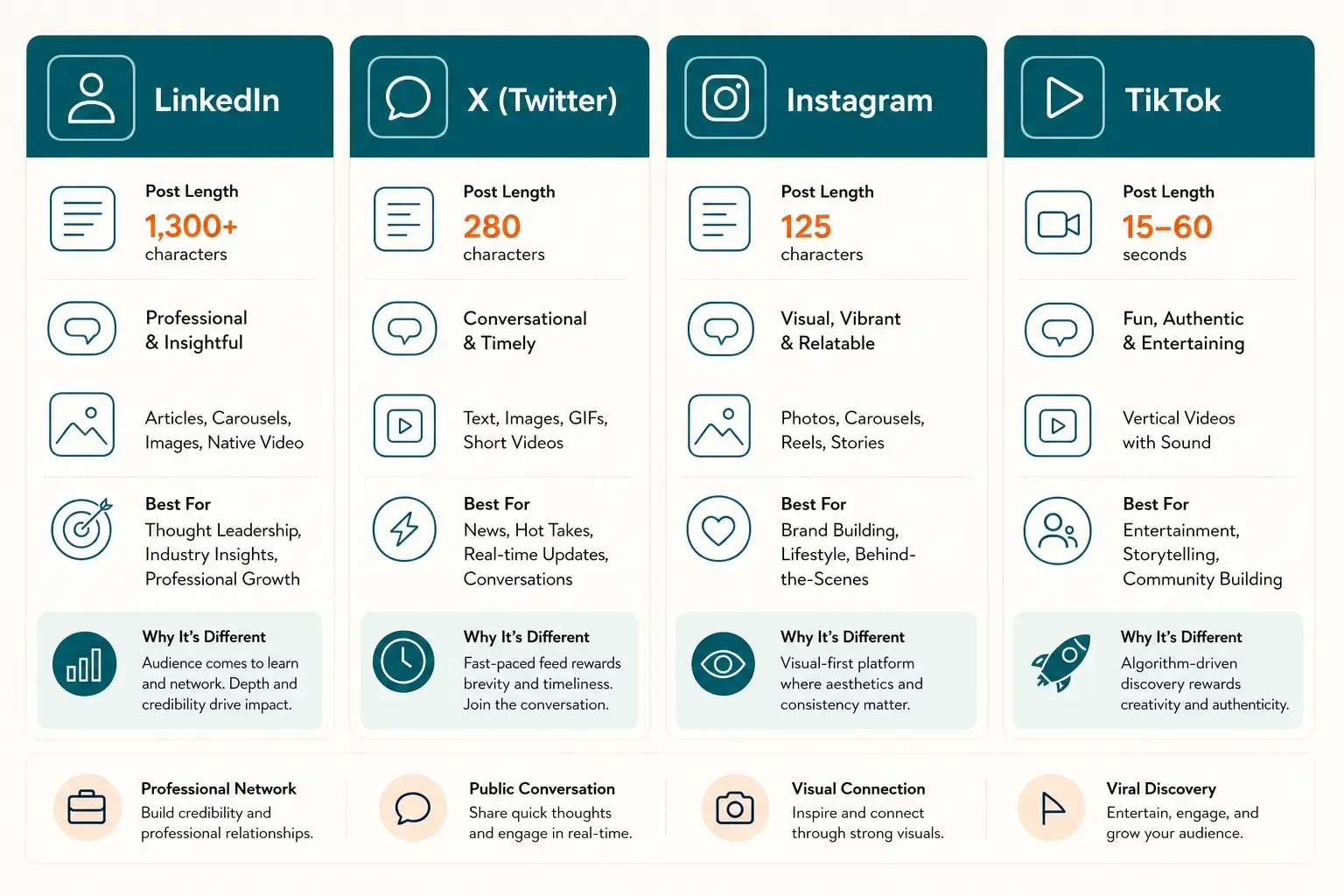
Platform comparison grid showing LinkedIn (professional, long-form), X/Twitter (snappy, conversational), Instagram (visual-first), and TikTok (authentic, short) with their distinct characteristics and best practices
LinkedIn: Professional Insight & Thought Leadership
LinkedIn’s algorithm and audience expect original thinking, not promotional fluff.
What works:
- Personal stories that connect to professional lessons (“I spent three weeks fixing this, here’s what I learned”)
- Original research or testing (even if it’s just 200 posts you analysed)
- Specific numbers and concrete examples, not abstract claims
- Contrarian takes that challenge to conventional wisdom
- Responses to industry trends and news
What doesn’t:
- Copy-pasting your company’s marketing copy
- Generic motivational quotes
- Asking people to click an external link (LinkedIn favours native engagement)
- Overly polished corporate speak
Tone: Professional but personable. You’re a human with experience, not a brand.
X is the platform for hot takes, live reactions, and threads exploring ideas.
What works:
- Timely commentary on what’s trending
- Data points that challenge assumptions
- Witty, opinionated takes (the algorithm rewards this)
- Long-form threads that build on each other (not character limits chopped into weird places)
- Engagement (replies, quote-tweets, conversations)
What doesn’t:
- Anything that looks like marketing copy
- Threads that could’ve been a blog post (too long, too formal)
- Engagement bait (“like and reply to enter a raffle”)
- Link dumping
Tone: Conversational, sharp, opinionated. The character limit (280 characters) forces clarity.
Important: X’s character counting includes weighted characters-links cost exactly 23 characters via t.co URL wrapping, emoji count as 2 characters, CJK characters (Chinese, Japanese, Korean) cost double. This means a post that looks like 270 characters in your notes app might already be over 280 when X counts it. Tools like Posttruncate’s X thread splitter account for this automatically, so you’re not guessing at where threads break. The tool also auto-splits long threads at word boundaries (not mid-sentence), which keeps your ideas intact and makes threads easier to follow.
Thread splitting is one of the biggest differentiators in X strategy. A single tweet that loses engagement because it’s truncated can sometimes perform 10x better when split thoughtfully into a 3-5 tweet thread. The format signals a deeper idea: algorithms reward long engagement (people reading multiple tweets), and the structure forces you to write the hook stronger since readers have to decide whether to expand each thread.
Instagram’s feed prioritises high-quality images and video (especially Reels). Text is secondary, but your caption still matters for hook and engagement.
What works:
- High-quality, visually consistent imagery (the single biggest factor)
- Reels over static posts (Instagram prioritises video, giving Reels 30%+ more reach than static)
- Behind-the-scenes authenticity and relatability (these often outperform polished content)
- Carousel posts that tell a story across multiple images (the swipe mechanic keeps people engaged)
- Captions that open with a hook (the first line appears before “See More,” so lead with what makes someone want to tap in)
- Questions that invite comments (“what’s your experience with this?”) which boost algorithmic visibility
What doesn’t:
- Low-quality screenshots or phone captures (unless that’s intentional authenticity you’ve committed to)
- Links in captions (Instagram doesn’t auto-link, so mention link-in-bio with a clear CTA)
- Pure text posts (Instagram isn’t Twitter; audiences arrive for visual content)
- Generic engagement bait (“like and comment to enter!”)
Tone: Conversational, authentic, visual storytelling. Less polished than LinkedIn, more curated than TikTok. Your brand voice should feel like a person, not a brand account.
The mobile fold issue: Like all platforms, Instagram cuts off captions. The first ~125 characters appear before “See More” on mobile, so your hook needs to land in that window. Posttruncate shows you exactly where Instagram will truncate on desktop vs mobile.
TikTok: Authenticity Over Production
TikTok’s algorithm rewards fresh, trending content and authentic personality over production quality.
What works:
- Trending sounds and formats (but adapted to your message)
- Authentic, unpolished content (filters okay, but overly edited feels fake)
- Educational content that entertains (quick tips, surprising facts, explainers)
- Personality-driven content (people follow people, not brands)
- Consistency over perfection
What doesn’t:
- Over-produced corporate videos (TikTok audiences smell it immediately)
- Anything that feels like a repurposed TV commercial
- Hashtag overload
- Ignoring trends entirely
Tone: Real, conversational, self-aware. Lean into humour if it’s authentic to you.
The Adaptation Workflow That Actually Works
Instead of creating 8 separate posts from scratch, use this framework:
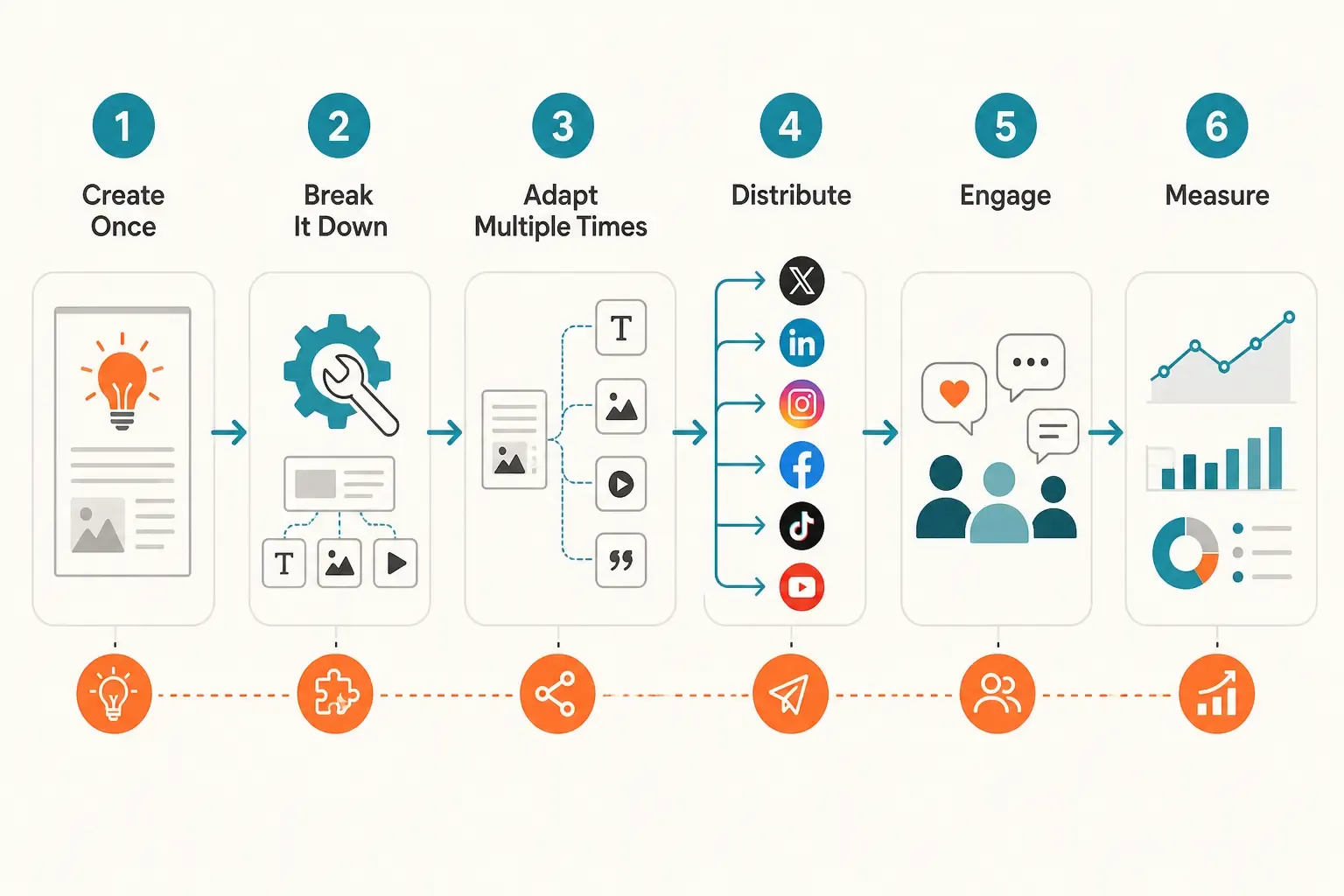
6-step adaptation workflow from Create Once through Breakdown, Adapt Multiple Times, Distribute, Engage, and Measure, with arrows showing progression and branching
Step 1: Create Once - Develop one core piece of content. Could be a blog post, a deep insight, research data, a story, a strong opinion. Invest time in this one piece.
Step 2: Break It Down - Extract:
- Key quote or stat
- The main insight
- Supporting evidence or examples
- Visual elements (images, charts)
- Emotional hooks
Step 3: Adapt Multiple Times - Rewrite for each platform using the components from Step 2:
- Start with the platform’s constraints (character limits, format, tone)
- Write the version that would work natively on that platform
- Use the original content as your reference, not your script
Step 4: Distribute - Use a scheduling tool (Buffer, Later, HubSpot), but paste custom copy for each platform, not the same caption everywhere.
Step 5: Engage - Monitor comments on each platform and respond. Engagement often matters more than the original post’s performance.
Step 6: Measure - Track metrics separately by platform. What works on LinkedIn might flop on X. Use this data to adjust future adaptations.
The time investment on Steps 1-2 is front-loaded. Steps 3-5 get faster the more you do them, especially if you build templates for each platform.
What Real Teams Actually Do
We talked to teams managing multi-platform presence at scale, and the patterns are clear:
On batching:
“I spend Monday writing and adapting all my content for the week. 2-3 LinkedIn posts, 5-7 X threads, 2 Instagram captions, 1-2 TikToks. It’s concentrated work upfront, then I just schedule and engage throughout the week.”
On respect for platform culture:
“The biggest mistake is forcing your brand voice onto every platform. X wants opinionated takes. LinkedIn wants professional depth. Instagram wants visual storytelling. If you’re the same everywhere, you’re probably wrong on most of them.”
On video:
“Video is non-negotiable now. A 30-second video repurposed into Instagram Reels, TikTok, and YouTube Shorts reaches way more people than text. We shoot one piece of video and that drives content for a month.”
On consistency:
“Better to post 2x per week consistently on 3 platforms than 5x per week sporadically on 8. Algorithms notice consistency. Audiences remember who shows up regularly. One platform done well beats eight done half-assed.”
You don’t need to reinvent this workflow from scratch. The right tools cut adaptation time in half.
Preview tools like Posttruncate let you write once and see exactly how your post will render on each platform-crucial for catching truncation points before they tank your engagement. LinkedIn’s mobile fold (different on desktop vs mobile), X’s 280-character hard limit, Instagram’s “See More” collapse-they’re all invisible until you preview. The tool also handles weighted character counting automatically, so you’re not doing mental math about emoji costs or link wrapper lengths. You paste your post, and you instantly see:
- Exactly where each platform will truncate
- How many characters do you have left before the fold
- Platform-specific character costs (links, emoji, CJK characters)
- Thread split suggestions for platforms that support them
That visual feedback alone saves hours of trial-and-error publishing.
Scheduling tools (Buffer, Later, HubSpot Social, Metricool) batch your posts and let you schedule across platforms. The key is customising the copy for each platform rather than using the tool’s “post to all” feature. Some of these tools actually integrate with preview tools now, so you can draft and preview in one place before scheduling.
Repurposing templates - Build simple markdown or Google Docs templates for each platform so you’re not starting blank each time. A template might be:
- LinkedIn: [Hook sentence that stands alone] + [3-5 sentences of insight or story] + [Original example or data] + [Call to engagement]
- X thread: [Opening hot take] + [2-3 supporting points as separate tweets, each interesting on its own] + [Question inviting replies]
- Instagram: [Emotional hook in first line (appears before truncation)] + [1-2 sentences expanding on the hook] + [5-7 emojis strategically placed for visual breaks]
Templates reduce decision fatigue and make batch adaptation something you can do in dedicated sessions rather than scattered throughout the week.
Common Pitfalls (And How to Avoid Them)
Pitfall 1: Copy-Paste Across All Platforms
The engagement difference is stark. Adapted posts outperform generic cross-posts by 3-5x. The moment you hit “post to all,” you’ve optimised for zero platforms instead of three. Don’t do it.
Pitfall 2: Ignoring Platform-Specific Character Limits
X’s 280-character limit isn’t a suggestion. LinkedIn’s mobile fold at ~140 characters on first-time view isn’t optional. Instagram’s “See More” collapse affects how many people see your full caption. Learn these constraints and design around them. Use Posttruncate as a reference if you’re not sure.
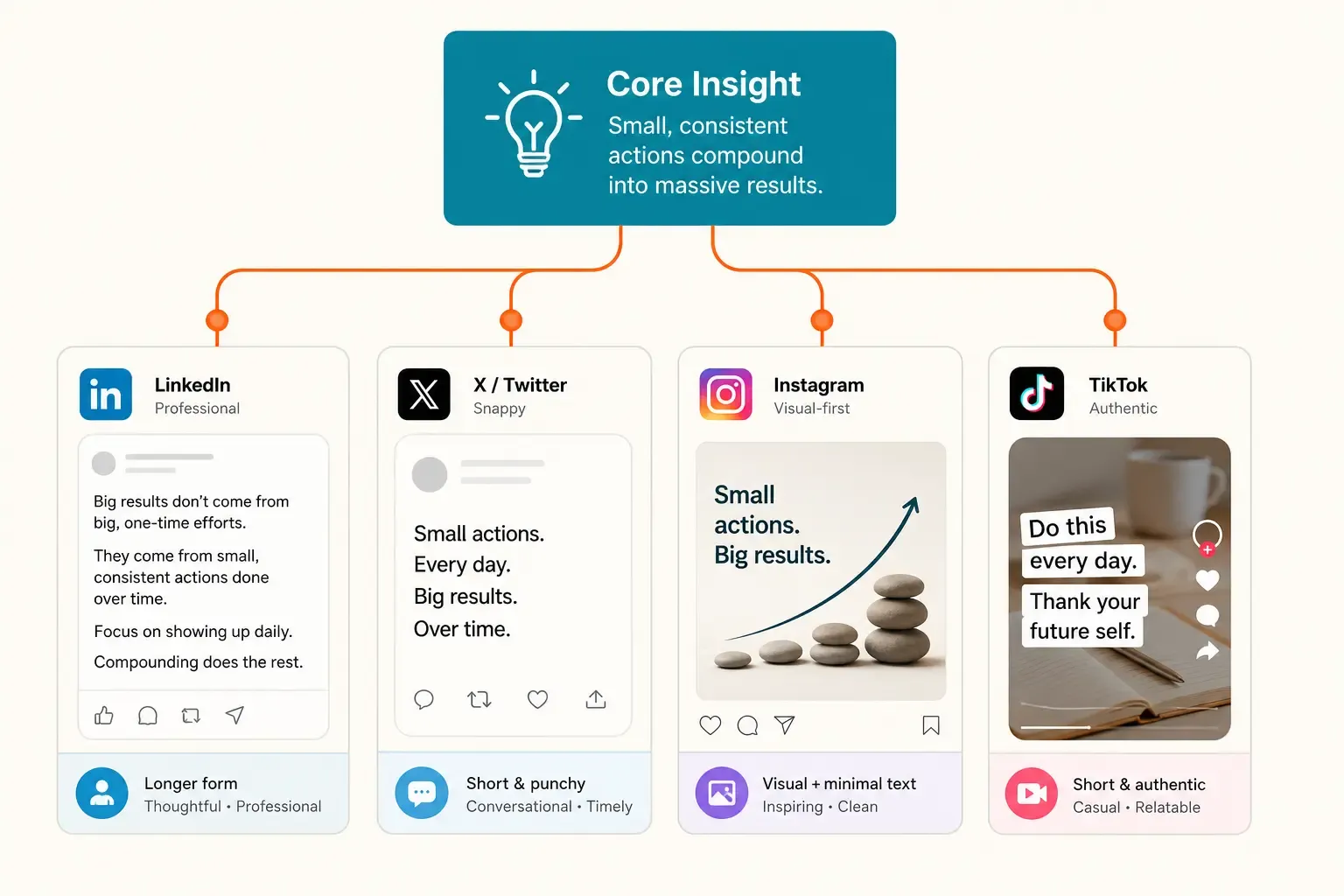
How one core message branches into four different adapted posts: LinkedIn version longer and professional, X version snappy and conversational, Instagram version visual-first with minimal text, TikTok version authentic and short
Pitfall 3: Creating for Platforms Where Your Audience Doesn’t Live
Not everyone needs to be on every platform. Start by identifying where your audience actually spends time. Create quality content on your core platforms instead of spreading thin across eight platforms where barely anyone you care about exists.
Pitfall 4: Posting Inconsistently
Algorithms notice. Audiences notice. One platform done well beats eight done sporadically. Pick 2-3 platforms you’ll commit to, then expand.
Pitfall 5: Measuring Everything by One Metric
LinkedIn success might be professional relationships and shares. X success might be replies and quote-tweets. Instagram success might be saves and shares. TikTok success might be comments and re-watches. Each platform’s culture rewards different behaviours. Don’t judge platform performance by the same yardstick.
Try Posttruncate
If you’re juggling multiple platforms and worrying about truncation, Posttruncate is built exactly for this problem.
Paste your post into their workspace, and you instantly see live previews of how it renders on LinkedIn, X, Threads, Instagram, Facebook, and SMS. The fold line shows you exactly where each platform will truncate your content on desktop and mobile. You see the “safe hook line”-how many characters are visible before the fold. Built-in character counting accounts for platform-specific rules: X’s t.co link wrapper, emoji weighting, CJK character costs, everything.
It’s free, no sign-up required, and your text never leaves your browser (runs entirely client-side). When you’re adapting posts across platforms, seeing the real preview before you publish beats guessing every time.
FAQs
Can I use the same post across all platforms?
Not really. You can reuse the core message and data, but each platform rewards platform-specific adaptation. A LinkedIn post that works won't land the same way on X or TikTok-audiences have different expectations, and each platform's algorithm favours different content types. One study found adapted posts get 3-5x more engagement than generic cross-posts. Start with one strong idea, then rewrite it for each platform's culture and constraints.
How much time does cross-platform strategy actually take?
More than broadcasting to all platforms at once, less than you'd think if you batch-create. Best-performing teams spend 3-4x longer creating adapted versions than one generic post, but they do it in batches (writing all LinkedIn posts for the week, then all X threads, then all Instagram captions). The key is building a repurposing system so you're not starting from scratch each time. Tools like [Posttruncate](/) help you preview exactly how each adaptation will land before publishing.
Which platforms should I prioritise if I can't do all of them?
Pick 3 maximum. Figure out where your audience actually spends time (LinkedIn for B2B professionals, Instagram for visual brands, X for real-time commentary, TikTok for younger demographics). Better to post consistently on 3 platforms than sporadically on 8. Once you have a sustainable rhythm on your core 3, then expand. Also: focus on platforms where engagement matters for your business goals, not just vanity metrics.
What's the minimum posting cadence to stay relevant?
2-3 posts per week minimum on each platform to stay visible in algorithms. That said, consistency matters more than frequency. Posting every other day forever beats 5 posts a week that you burn out on after a month. Set a cadence you can actually maintain. Also remember: engagement and community interaction (responding to comments) often matters more than raw post frequency.
How do I know if a platform is actually worth my time?
Track metrics separately for each platform for 4-6 weeks. Look at engagement rate (not just views), click-through rate if you're linking, and conversions if that's your goal. A platform with 100 engaged followers often beats one with 10,000 passive ones. If a platform isn't moving the needle after a solid effort (consistent posting, authentic engagement, platform-appropriate content), reallocate that time to channels that work. Don't stay out of obligation.

Join the discussion
Comments are reviewed before they appear, so yours won’t show up right away.